I believe there are no privileged disciplines except for personal sensibility.
Giorgio Griffa
Created in a state of “passive concentration”, where the hand and mind follow what is produced on the canvas, Giorgio Griffa’s paintings contradict themselves; both intuitive yet rational, restrained yet subtly lyrical. Grouped into thirteen non-chronological cycles, his works scrupulously follow a pictorial language formulated by Griffa in the 1960s, each cycle using the same universal symbols – lines, dots, geometric forms and repeating linear patterns, often in dialogue with letters or numerals.
Considered to be a part of the Arte Povera generation emerging from Turin, Griffa gravitated more towards the medium of painting than his peers, and in any case, the grouping of artists such as Giuseppe Penone, Carol Rama and Giulio Paolini, to name a few, resisted a collective style through individual research and approaches. Like writing, Griffa’s paintings read left to right, placing symbols starting from one end of the canvas to the other. Lines, waves, Greek frets and arabesques sit apart from the bare canvas in bright, artificial colours reminiscent of the colours of the Mediterranean and Italian fresco painting. Painted in primarily acrylic, tempera and watercolour and often diluted, they are painted atop raw canvas laid flat on the floor so as to prevent the liquid colour from dripping.
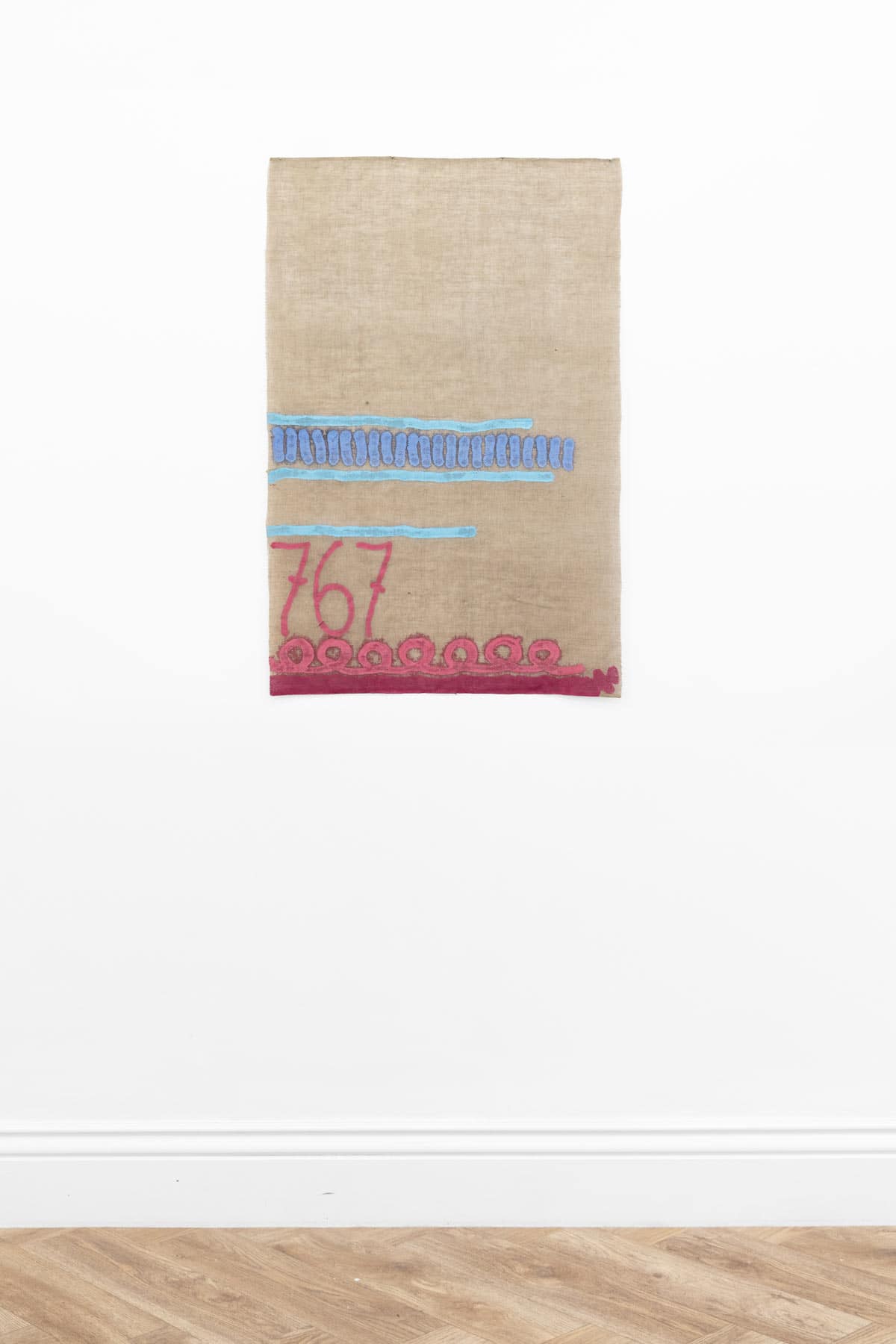
Giorgio Griffa, Tre Linee Con Arabesco n. 767 [1993]
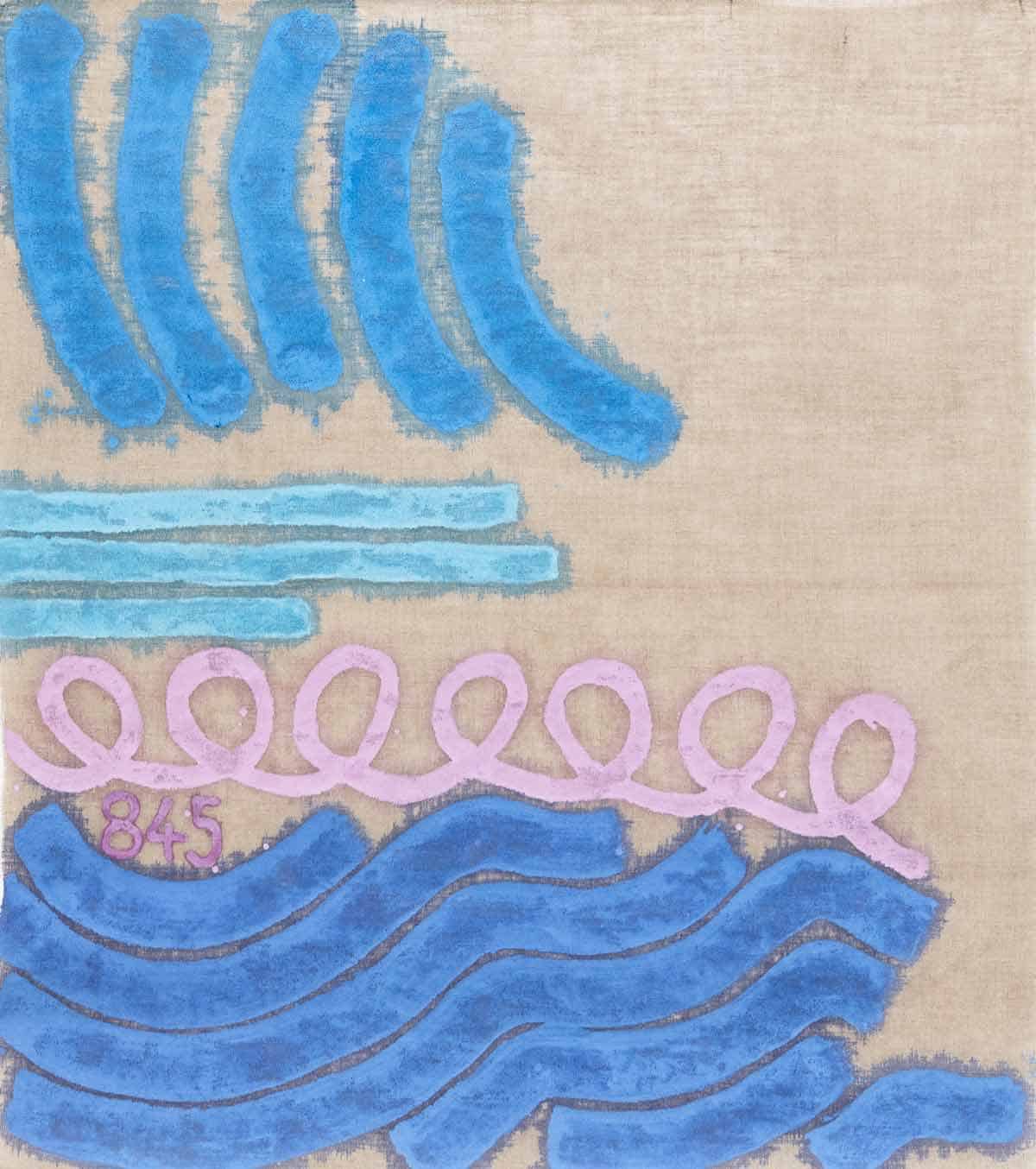
In Tre Linee Con Arabesco n. 845, this mode of working is rendered visible through the homogenous spreading of colour from thick wavy lines, which gradually become disordered as they move along the canvas. Their edges are clearly delineated, set against the soft blur of the diluted acrylic which begins to adopt the texture of the canvas. Nestled underneath the organic curves of a soft pink arabesque, the painting’s number, 845, is painted carefully, central to the composition. The cycle Three Lines and an Arabesque marks the beginning of Griffa’s use of numbers within his work, also used in Tre Linee Con Arabesco n. 767, where a much larger and delicate 767 adopts a slight figuration, perched atop a groundscraping arabesque, this time in a deeper pink. Large swathes of the canvas are intentionally left unfinished, an investigation into the “temporary nature of knowledge”, where, to quote Griffa, “painting itself is provisional knowledge.”
With the advent of the ‘Canone Aureo’ cycle in the 2000s, Griffa’s numbers took on a new significance – at first a mere way of establishing order, his interest in the golden ratio was a descent into the unknown. Sprawling fluorescent digits strewn across the canvas referenced the ratio’s infinite reach, curling at the ends like a tail such as in Sezoine Aurea. Amidst contrasting bright blue lines, they rapidly sweep across the canvas underneath an overlapping assemblage of freeflowing curves – loose and amorphous, hazy fields of blues, pinks and oranges cross over one another. The numbers are buoyant, precisely painted, ebbing to and fro jubilantly. In its endless digits, the ratio represents the journey into the unknown – 1.6 will never become 1.7 – painting, in the same way, does not seek to represent the world but to know it and actively construct it.
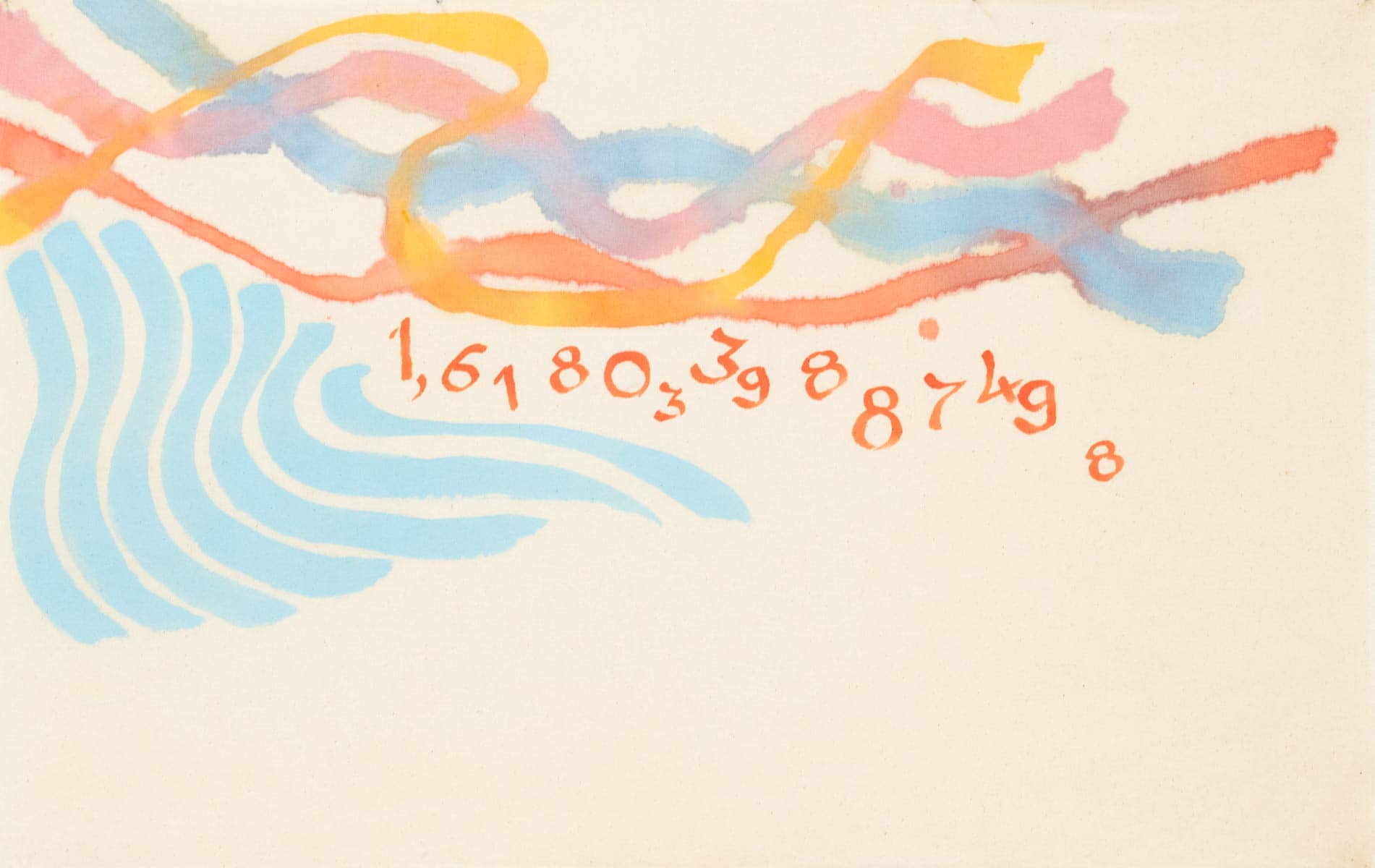
Giorgio Griffa, Sezione Aurea [2009]
Inspired by the later work of Matisse, the same radical reduction of form can be seen in Griffa’s repeated lines and patterns, balancing the tension between sign and colour. His work is universal, and extends to the viewer an implied philosophy, however resists a fixed meaning, preoccupied instead with the idea of the memory of painting. Half finished, his compositions cease once Griffa is interrupted. Painting in a trance-like state, he allows his instruments to be an extension of his own limbs, the canvas a physical fragment of a discontinuous, constantly expanding place. The symbols it holds are deliberately simple, anonymous figures which could “belong to anyone’s hand”, borrowing from Indian philosophy. Like meditation, the repetition of these symbols are less about representation as they are about existing – each sign is new in the “eternal novelty of every act of life”
(By Emily Naughton)