
I feel most alive and most like myself when I am alone. I also find my experience of the world when I am alone to be more meaningful and profound.
Emily Pettigrew2025
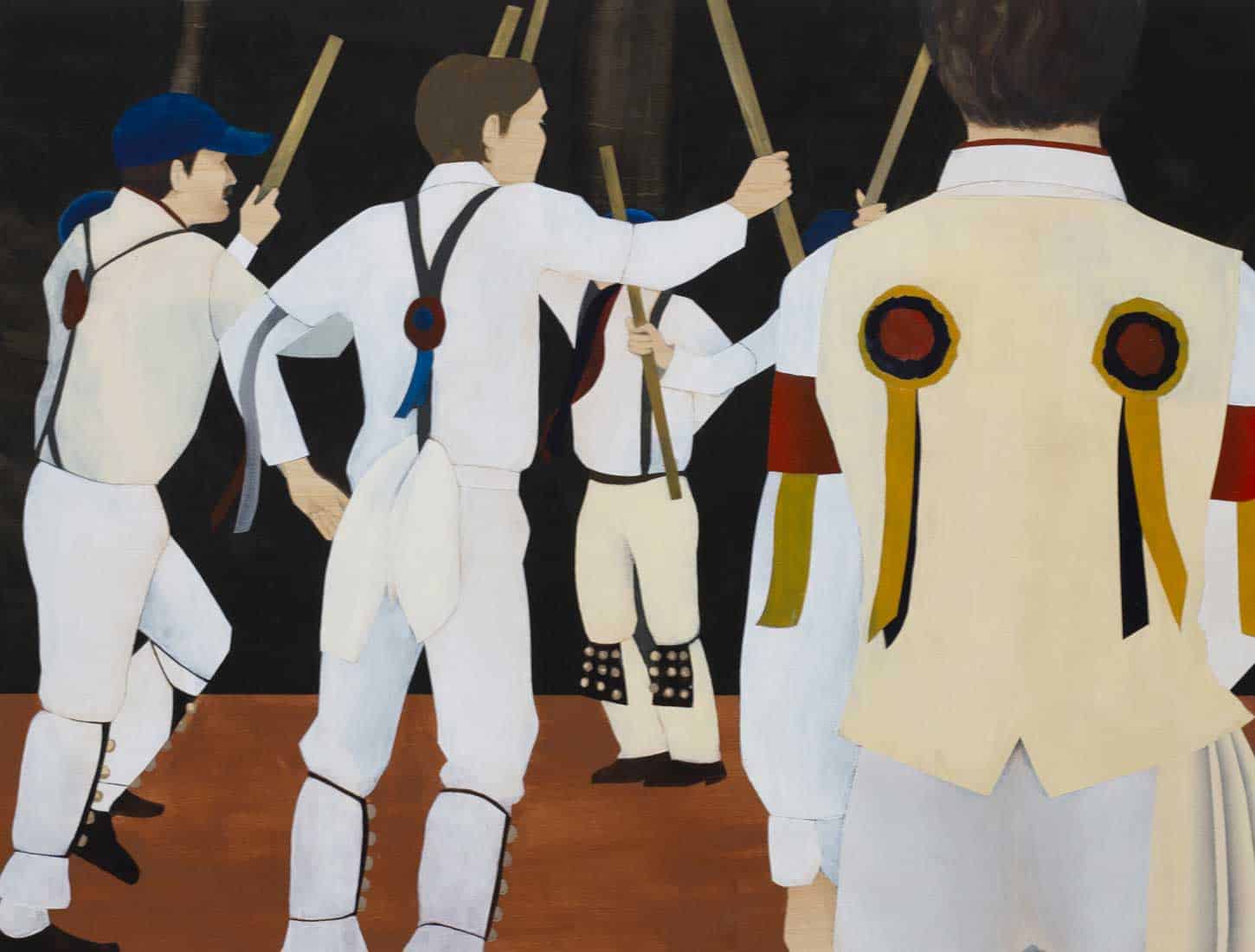
Emily Pettigrew, The Morris Men, 2025
Emily Pettigrew, native of Maine and currently based in the Catskill Mountains of New York State, crafts visual narratives that are both intimate and deeply rooted in the life and culture of the American Northeast. Her paintings, often inspired by literature and cinema, tell stories from a quietly constructed world: a fantasy carefully shaped through flat layers of colour, which blurs the line between the familiar and the unknown.
In her latest series of paintings, Pettigrew once again blends history with fantasy, collective tradition with self-introspection, culminating in a sublimation of reality in which time unfolds at a rhythm of its own. These works, executed on wood panels, offer a glimpse into a parallel world over which the artist exerts full control. As Pettigrew notes:
“I think the Spartanism of the Maine landscape and architecture leaves a mark on all its artists. People like Will Barnet, Alex Katz, Andrew Wyeth, and Fairfield Porter all have a cleanliness and clarity to their work that is very characteristic of New England. I see myself as part of that tradition of Maine painters.”
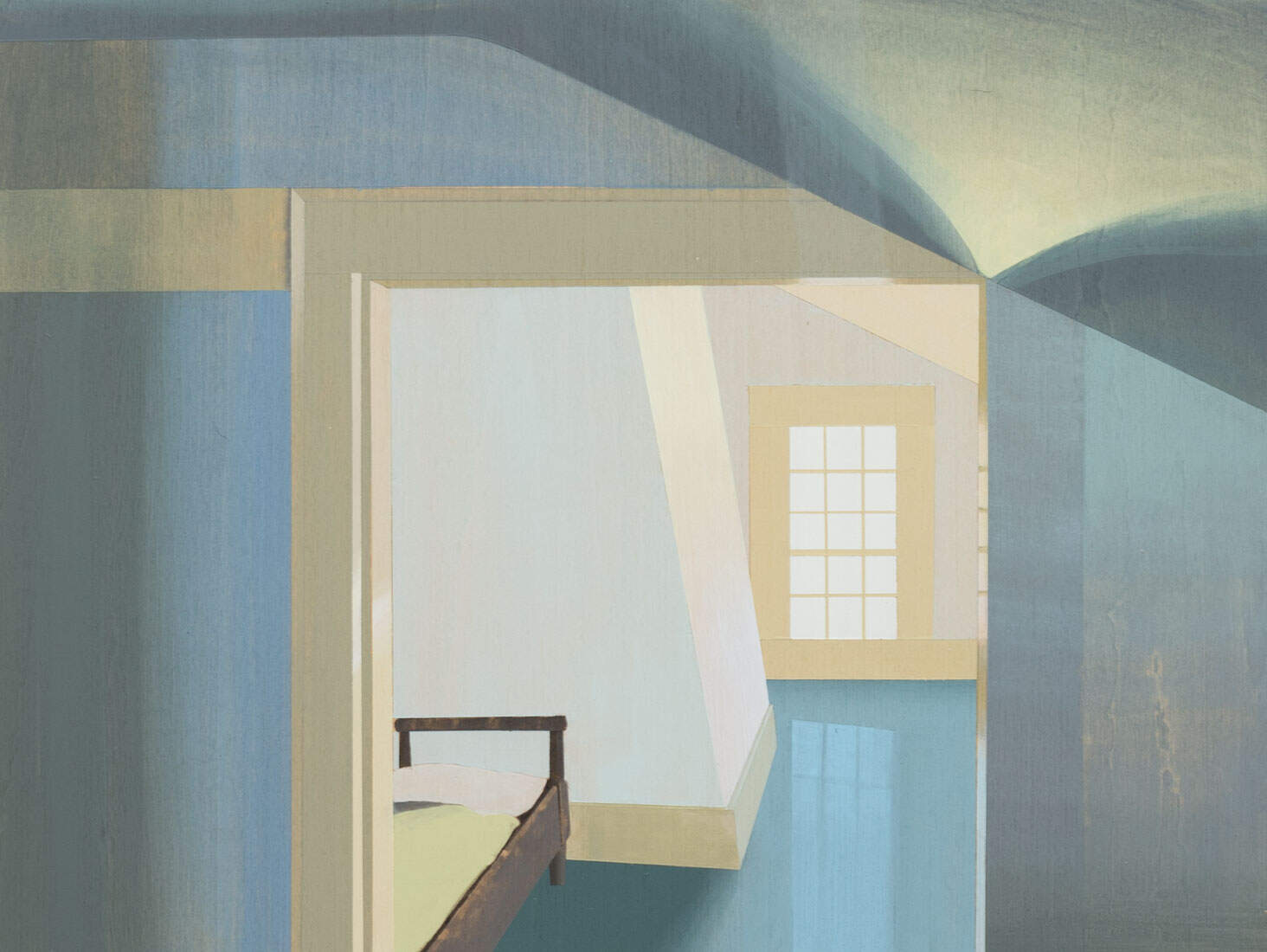
Her paintings not only evoke the metaphysical essence of the region, but depict its distinct traditions. Sugaring Season, references maple syrup production, the saccharine subject contrasted against the hollow window and solid forms of a house in the background belie an undercurrent of something darker. The Morris Men, depicts a traditional dance brought to America by English immigrants and grown into an enduring part of East Coast folklore. Pettigrew’s iconography speaks to the central role of mythology in the history of the white settler movement and its importance in the country’s nation building.

While deeply rooted in a wider art history, Pettigrew’s paintings are also personal explorations. Her works capture a profound sense of introspection and solitude, as Pettigrew describes it a “predilection to isolation”: “I feel most alive and most like myself when I am alone. I also find my experience of the world when I am alone to be more meaningful and profound.” The artist’s practice deftly charts the boundaries between presence and absence. In Indentured Girl’s Room, glimpses of a young woman’s life are revealed through her absence, while the faint figure behind the glass window in The Approach reveals a faint figure behind a window, simultaneously knowable and unknowable.
(By Anna Suigo)