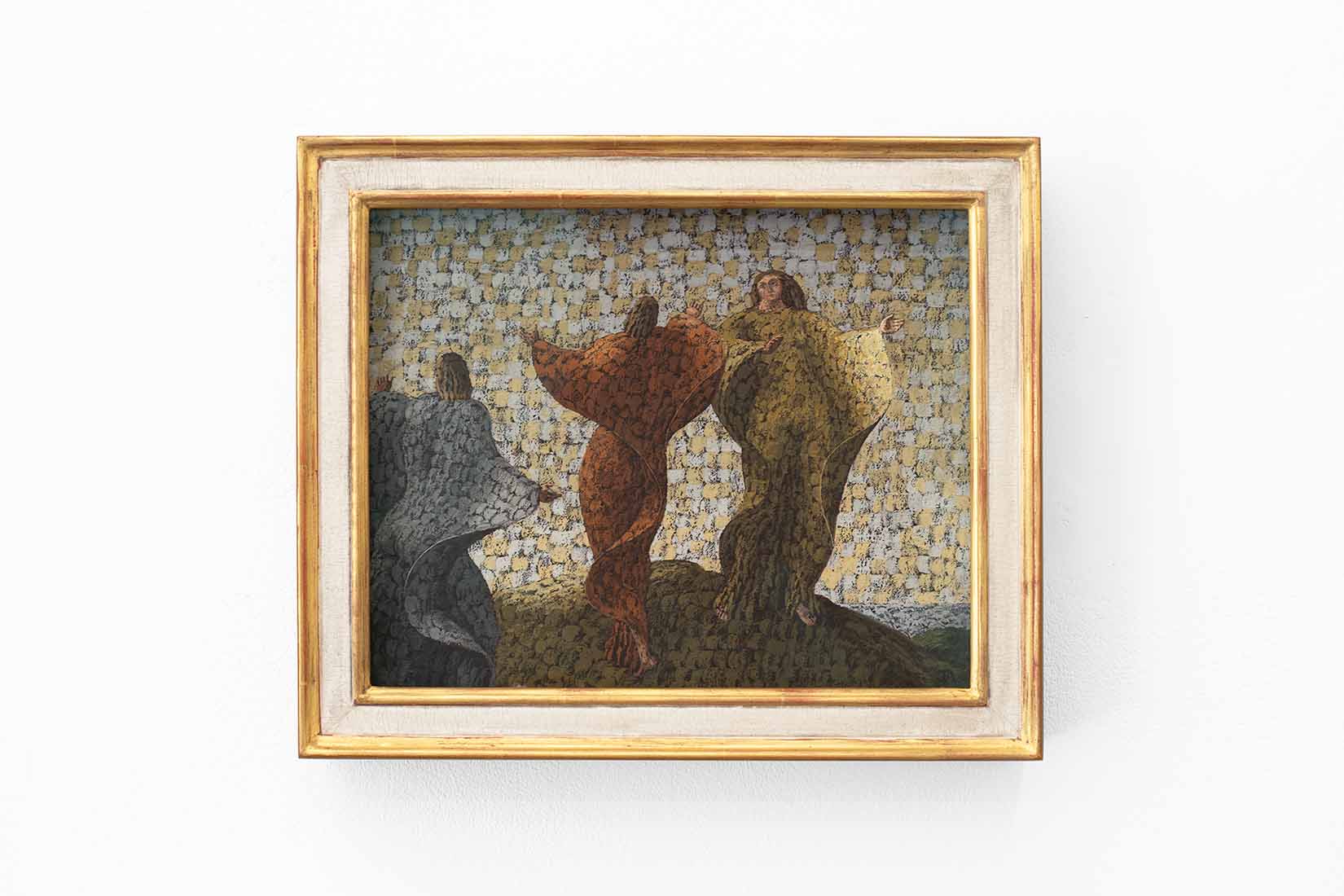
Group of Figures presents three figures draped in flowing garments of blue, red, and yellow, gathered in a circle, as if moving to music we cannot hear. Their bodies lean gently toward one another, arms thrown open and their classical-inspired clothing unfolding in geometric shapes.
Anna Suigo
Painted in 1945, the last year of the Second World War, Group of Figures reflects John Armstrong’s deep fascination with classical themes and Renaissance tradition, while simultaneously capturing the complexity of the post-war era. Often associated with British Surrealism, Armstrong contributed to shaping the landscape of British art after the First World War through works imbued with witty symbolism and subtly infused with political messaging.
Group of Figures presents three figures draped in flowing garments of blue, red, and yellow, gathered in a circle, as if moving to music we cannot hear. Their bodies lean gently toward one another, arms thrown open and their classical-inspired clothing unfolding in geometric shapes. The movement of the figures, accentuated by the billowing folds of their garments, evokes the vibrant compositions and treatment of drapery characteristic of the Italian Renaissance masters.
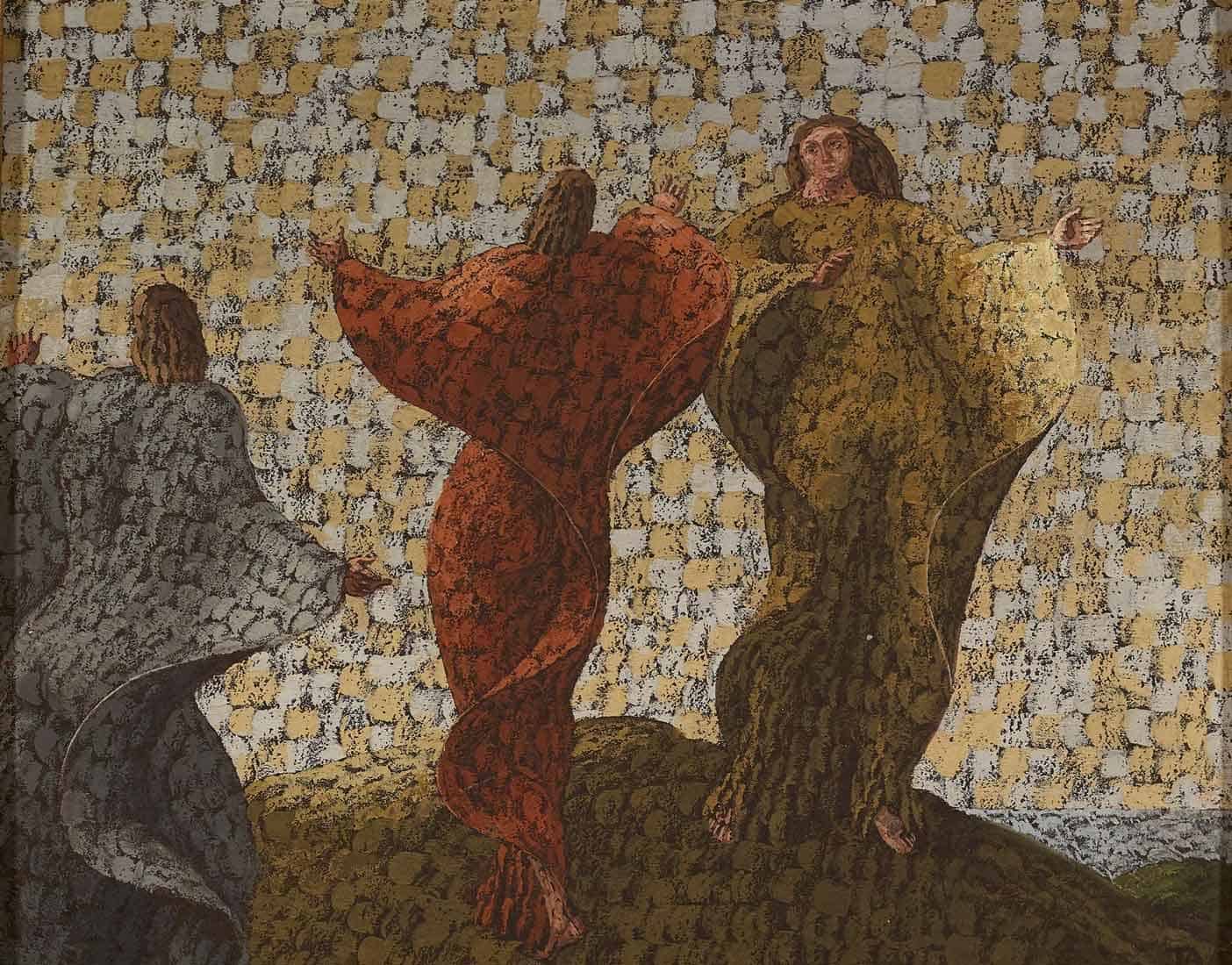
John Armstrong, Group of Figures, 1945.
A barren hill, a distant expanse of water, and a diffuse, golden light confer on the scene a sense of cryptic tranquillity. Armstrong’s figures inhabit a timeless, liminal space, much like the sibyls and prophets painted by Michelangelo on the ceiling of the Sistine Chapel, or the three Graces in Botticelli’s Primavera. Situated between history and myth, their contemplative attitude assumes particular significance within the context of post-war Europe, and a certain melancholy emerges in Armstrong’s blending of classical elegance with a pervasive sense of suspension. This tension between the idealised forms and solid volumes of Neoclassicism and the fractured reality of the modern world is subtly reinforced by Armstrong’s technique. The entire surface of the painting is divided into a grid of small coloured squares shimmering like tesserae of a Byzantine mosaic.
Group of Figures reflects Armstrong’s training as both a painter and a muralist and reveals an ongoing dialogue with the art of the past. Armstrong’s reference to tradition extends beyond iconography and composition, it is embedded in the materiality of the work itself. By working in egg tempera, the favoured medium of Renaissance painters before the rise of oil painting, Armstrong deliberately aligns himself with the specific legacy of that tradition.
In its intimate scale and compositional clarity, the painting echoes the format of a predella panel, those small narrative scenes adorning the base of altarpieces. Evoking the traditions of religious painting, the painting’s symbolism is, however, distinctly secular. In this way, Armstrong’s figures resist definitive interpretation. Who are they? Perhaps modern prophets and sibyls, heralds of a new era taking shape in the wake of war.
(By Anna Suigo)