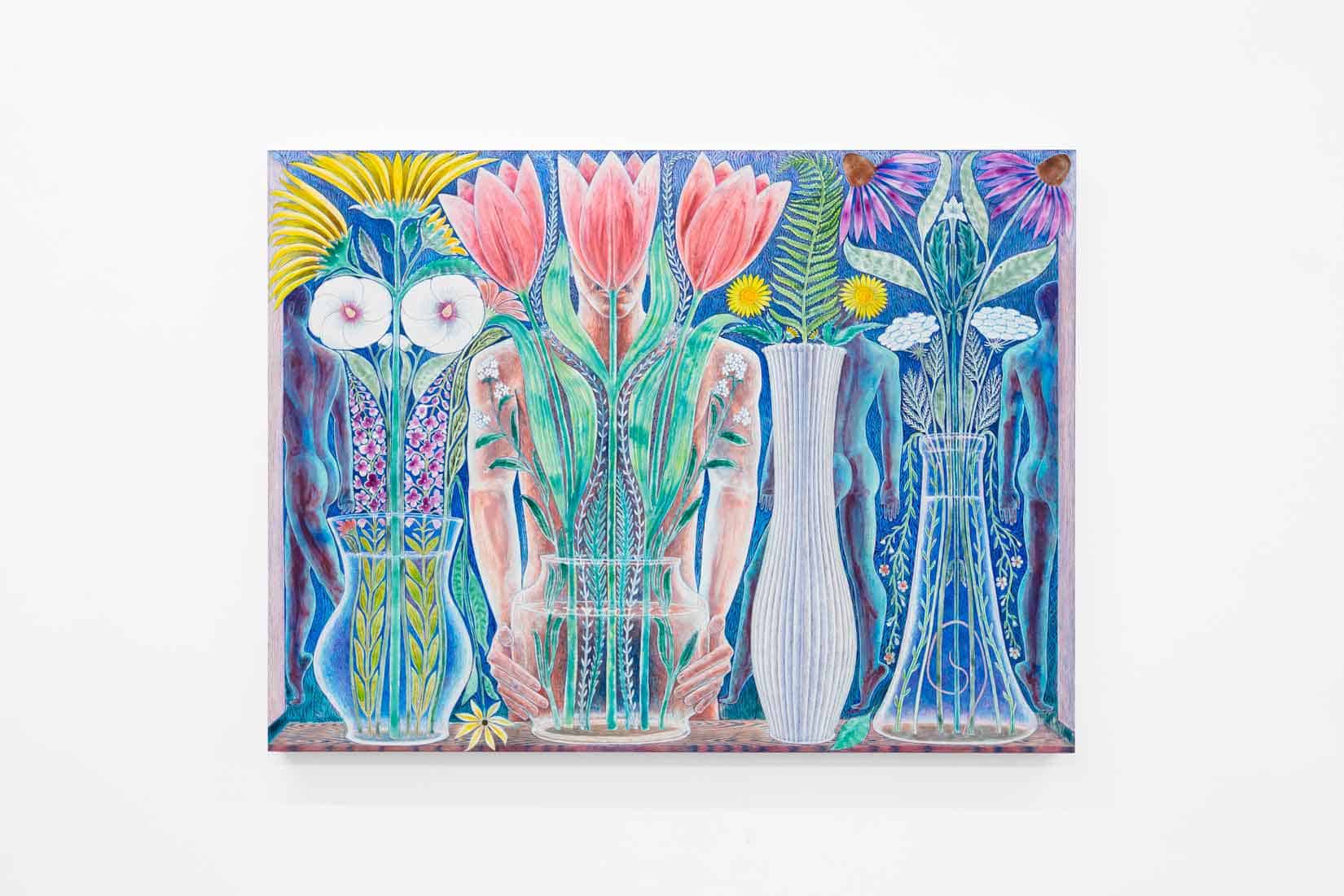
Everything is shortened to where it’s almost puzzled together.
Bryan Rogers2026
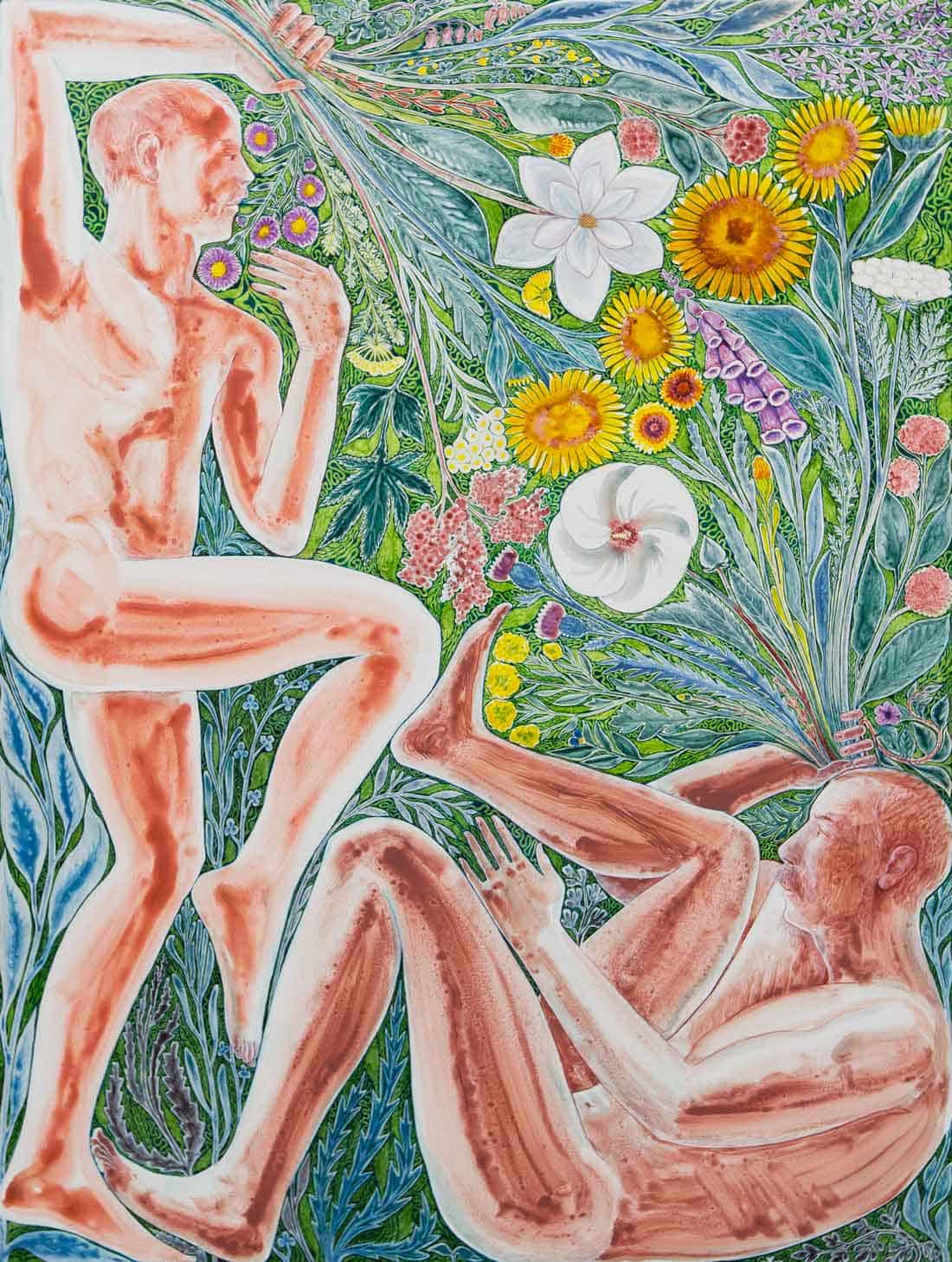
Brayn Rogers, Flower Fight, 2026
This text was commissioned for the artist’s first solo exhibition with the gallery A Bouquet, presented at our Maddox Street gallery. Gemma Rolls-Bentley is a curator, writer, creative consultant based in London.
There is a particular, quiet alchemy in the way Bryan Rogers constructs a painting. It is a practice rooted in a domestic, almost meditative ritual that begins long before a brush touches a panel. Each work starts as what the artist calls a “scribble little thumbnail” in a sketchbook – a vital mapping process where he solves spatial puzzles and finds a path through the composition. Once on the surface, however, the rigidity of planning gives way to intuition. “It comes to you as you’re going through it,” Bryan tells me, “it doesn’t really take a pre-thought out direction.” Working primarily in acrylics thinned to the consistency of ink, Bryan builds his images through watery under-paintings and layered washes, a technique that imbues the work with a chromatic depth reminiscent of the faded grandeur of a weaver’s loom.
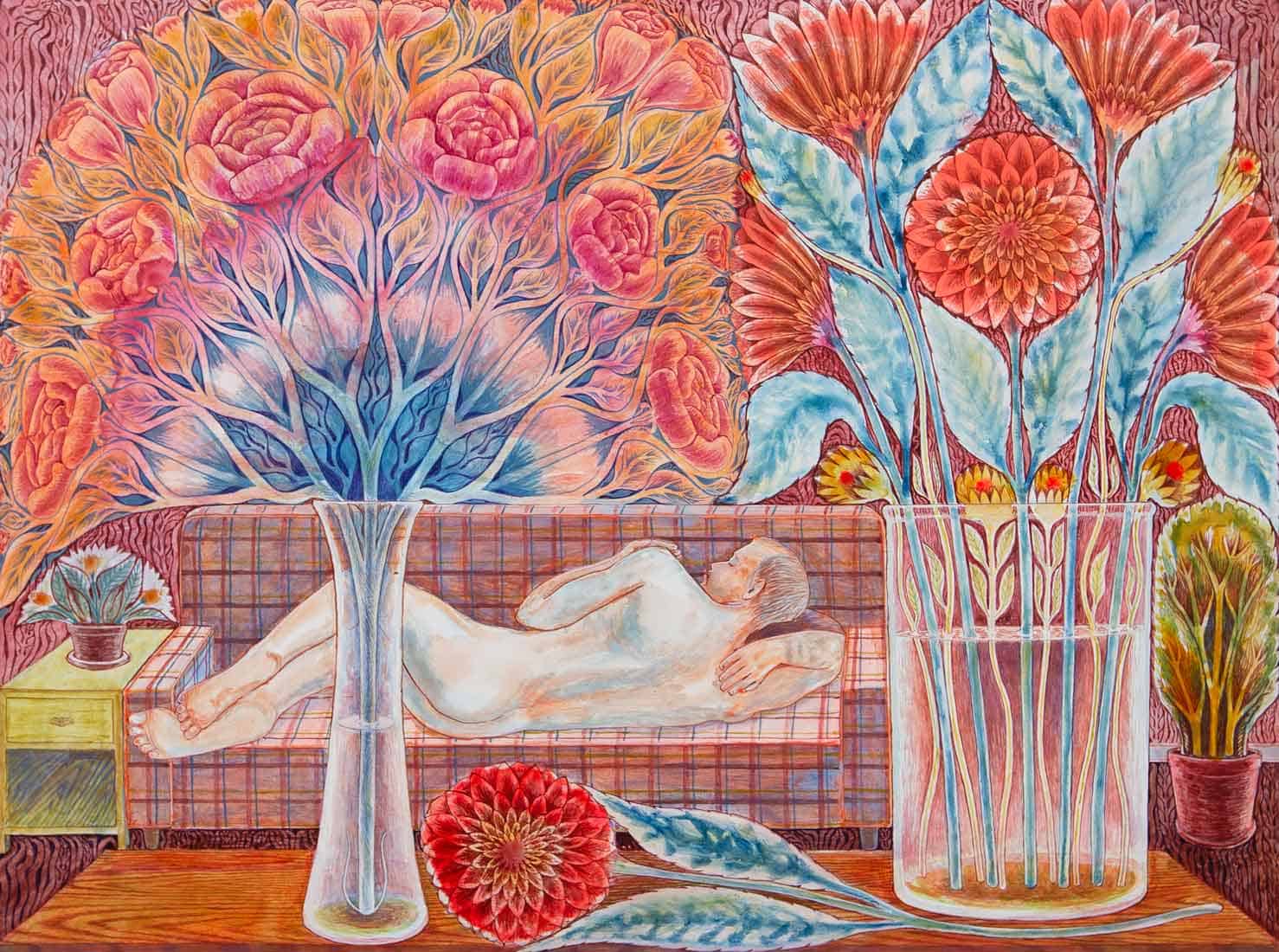
Rather than relying on a single viewpoint, Bryan’s paintings embrace multiple perspectives. Figures are puzzled into the frame alongside domestic objects and botanical motifs, creating a flattened, rhythmic equilibrium. The artist’s father was a computer engineer, and there seems to be an inherited “engineering quality” to the way his brain organises a canvas. He is constantly thinking about how multiple elements can occupy the same compositional space, resulting in a world where “everything is shortened to where it’s almost puzzled together.”
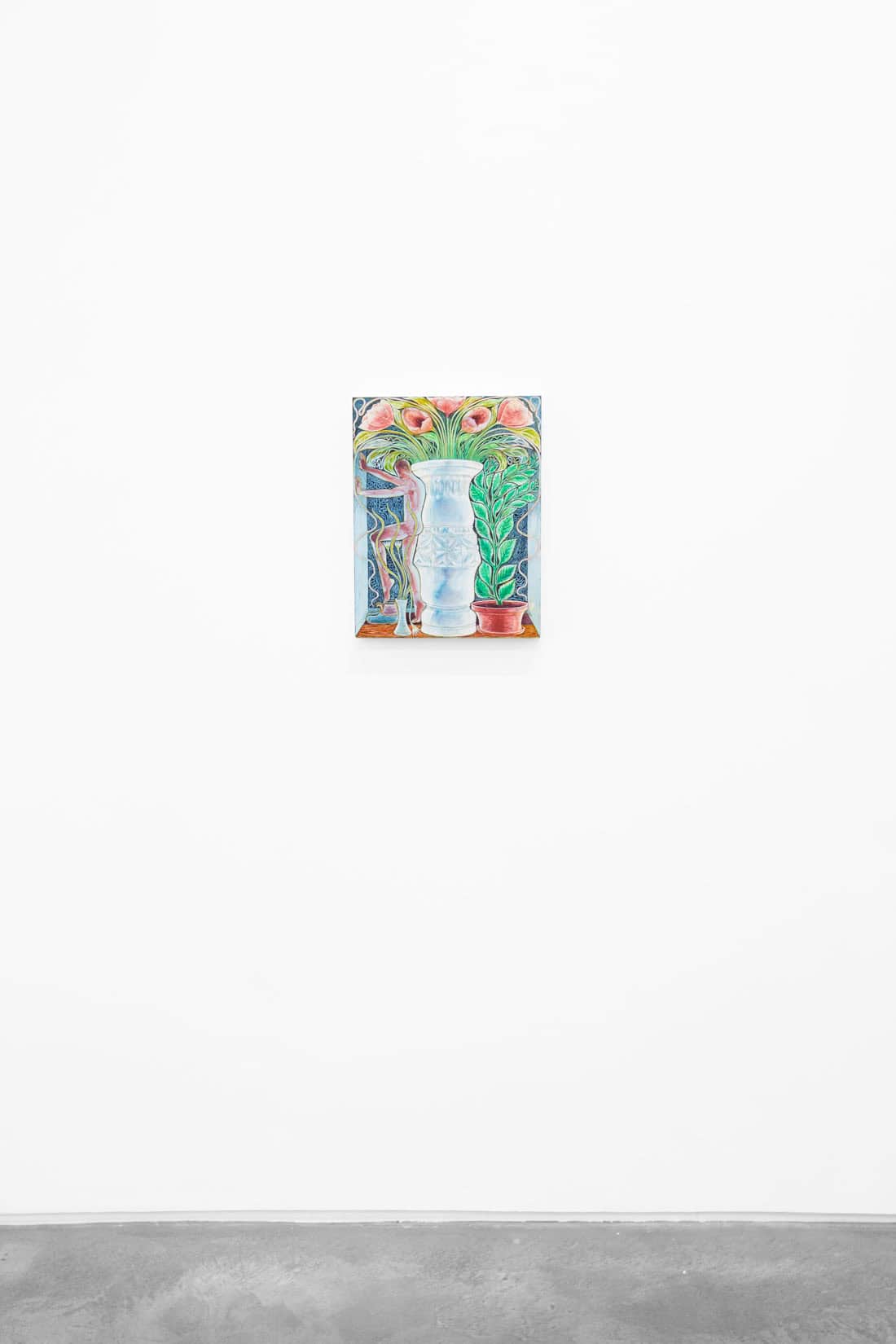
The paintings feel art historical in their approach – the decadent line-work of Aubrey Beardsley, the organic patterns of William Morris, and the visionary page layouts of William Blake are all reference points for Bryan. We see echoes of Duncan Grant, specifically the way Grant would literally fit bodies into the architecture of a space, painting figures to curve and settle within the physical constraints of a door frame or a mantelpiece at Charleston. In Bryan’s work, this manifests in the way that figures meet architectural or decorative components within his painted worlds. Such as a figure’s back pressed against a large urn; the two elements occupy different planes, yet their outlines mirror one another so perfectly that they appear as a single, interlocking unit.
Bryan cites the Unicorn Tapestries as a touchstone for this way of seeing. These seven world-renowned medieval hangings, housed at The Cloisters in New York, depict the hunt of the mythical creature across a “millefleurs” background – a thousand flowers. In these tapestries, the perspective is tilted; every inch of the landscape is filled with flora and fauna, creating a dense, airless, yet beautiful thicket. Bryan translates this into a contemporary language, where bodies are woven into the “tapestry” of the panel, caught in a foreground that is indistinguishable from the background.
The sensitivity with which Bryan approaches the queer body is deeply influenced by those closest to him. Growing up in a conservative family, he found a vital confidant and queer role model in his brother, a dancer just fifteen months his junior. His brother’s unapologetic visibility as a performer, particularly his stint as a naked “living statue” in Marina Abramović’s The Artist is Present at MoMA, gave Bryan a profound sense of personal and artistic permission. This early appreciation for the vulnerability of the exposed body has clearly travelled from his brother’s stage into Bryan’s studio, where he treats the figure with a distinct reverence and tenderness, even when the scenes themselves are fraught with tension. To capture this, Bryan frequently uses his own form to dictate the postures of his subjects. These are strictly not selfportraits, however. His body acts simply as a vessel to explore form and composition, creating characters that are both deeply personal and universal.
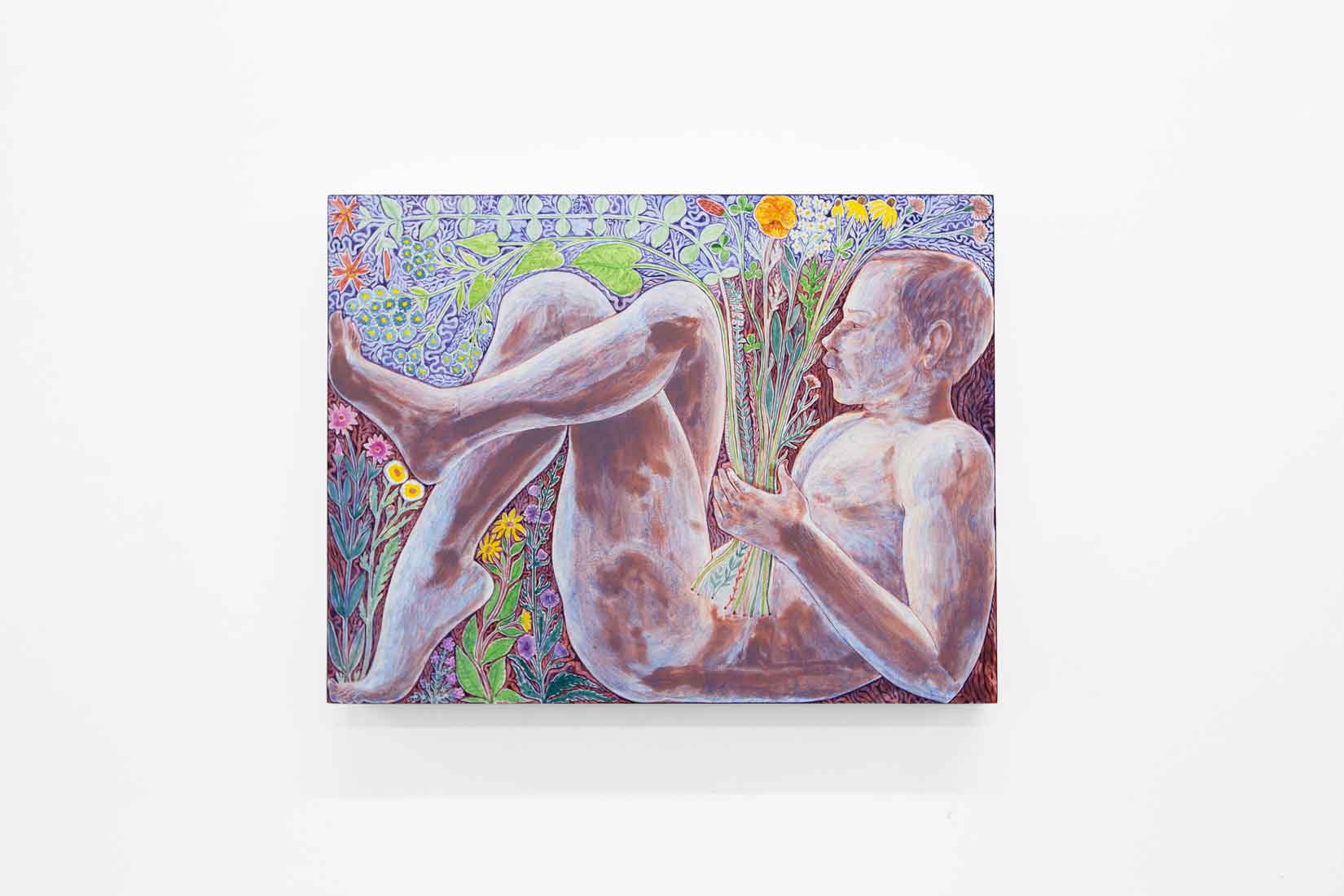
Crucially, these works propose the natural world as a sanctuary. There is a kinship between the queer bodies in these paintings and the organic forms they share space with. For me, there has always been something particular in how queer bodies situate themselves within nature. Away from the heteronormative structures of the city or the domestic interior, the natural world offers a space of total, radical acceptance. Bryan’s compositions suggest an air of tension as the various elements find a tightly balanced resolution within the edges of the paintings. Nude male forms jostle with flowers, finding balance in a gentle juxtaposition that challenges traditional power dynamics. In a world that often demands a performative or toxic masculinity, Bryan’s figures find solace in their vulnerability. For the artist, these are explorations of the sensitive, beautiful facets of being a man.
These paintings do not seek to provide a literal autobiographical record, but rather to offer an openended reflection on identity. Whether depicting the same figure repeatedly to suggest a shift in time or using the body to explore different psychological states of anxiety and peace, Bryan’s work remains an invitation to look closer. In the lush, entangled world of A Bouquet, he manages to capture that elusive feeling of not quite fitting in and transforms it into a world where everything fits perfectly
(By Gemma Rolls-Bentley)