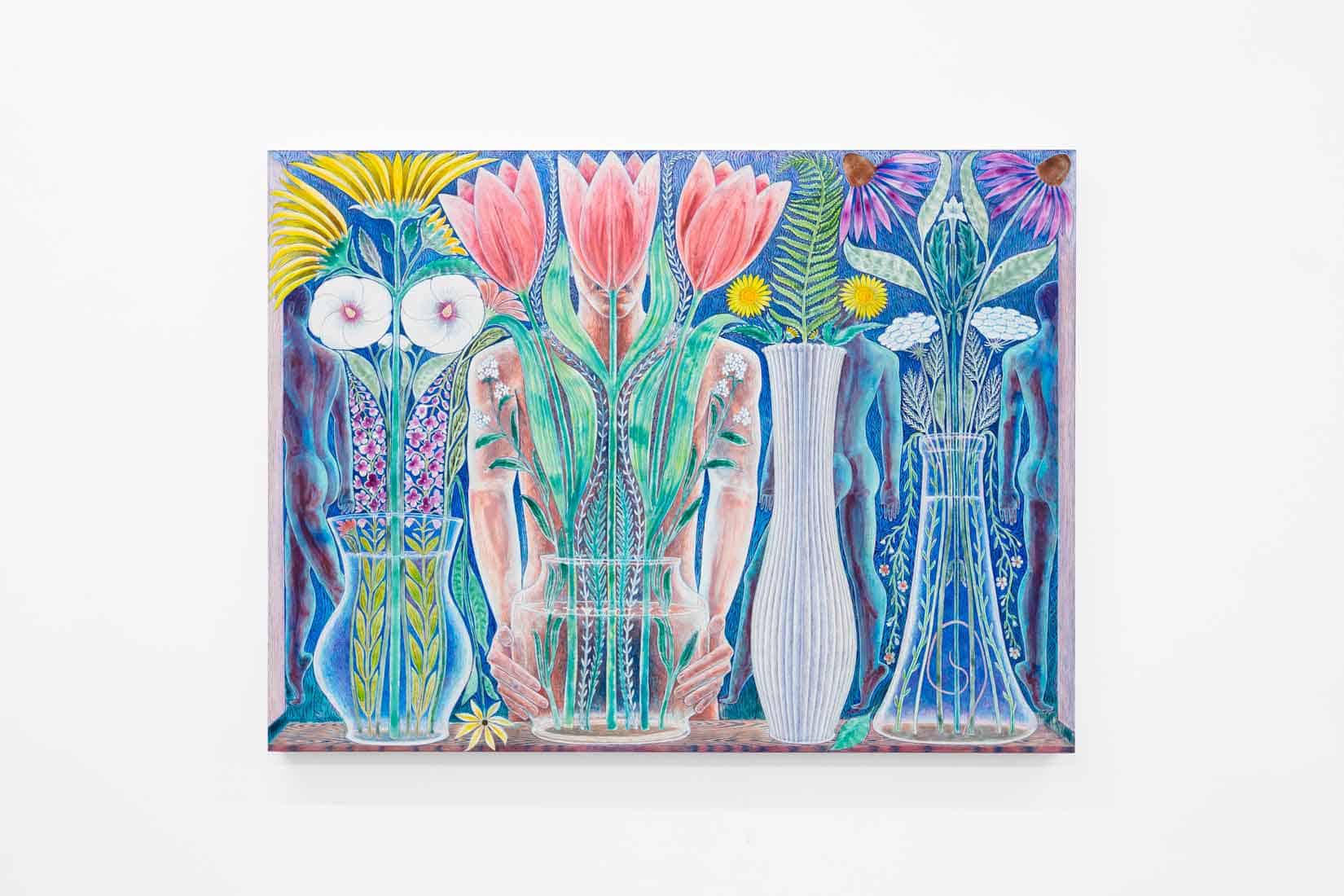
I think of them as being in a Garden of Eden, pre-sin state of existence.
Bryan Rogers
Naked bodies painted in twilight tones saunter through a floral thicket, awkward yet flamboyant, reminiscent of Egyptian statues or Greek sculptures. Wedged between a host of lively flora, painted in vivid yellows, magentas and turquoise, these muscular forms align with sinuous curves – a string of flowers cascades along an accentuated calf, a bright white flower gently nestles itself into the nape of a neck. Framed on three sides by light pink walls, this otherwise edenic scene adopts an air of domesticity, anchored by the four vases which align a countertop. Its grained surface seen in perspective recalls psychedelic motifs, one of Bryan Roger’s key influences alongside the movements of Art Nouveau and the Viennese Secession.
Visible through the transparent vases and in the same indigo tones of the male figures, a subtly contrasting background of floral shapes emerges. Like a William Morris tapestry, the additional dimension of undulating forms animates the entire scene. This quietly pulsating movement rejects the otherwise considered composition, where domestic objects, botanical motifs and figures are rigorously pieced together. Rogers’ use of acrylic paint is as precise as his composition – thinned and layered, it gives the impression of watercolour or ink, creating sharp moments of contrast. The immensely detailed edges of leaves, gentle glint of the reflection on glass vases, painstakingly erect stems converge onto one flat plane, their multiple perspectives subverted to create relationships between the forms.
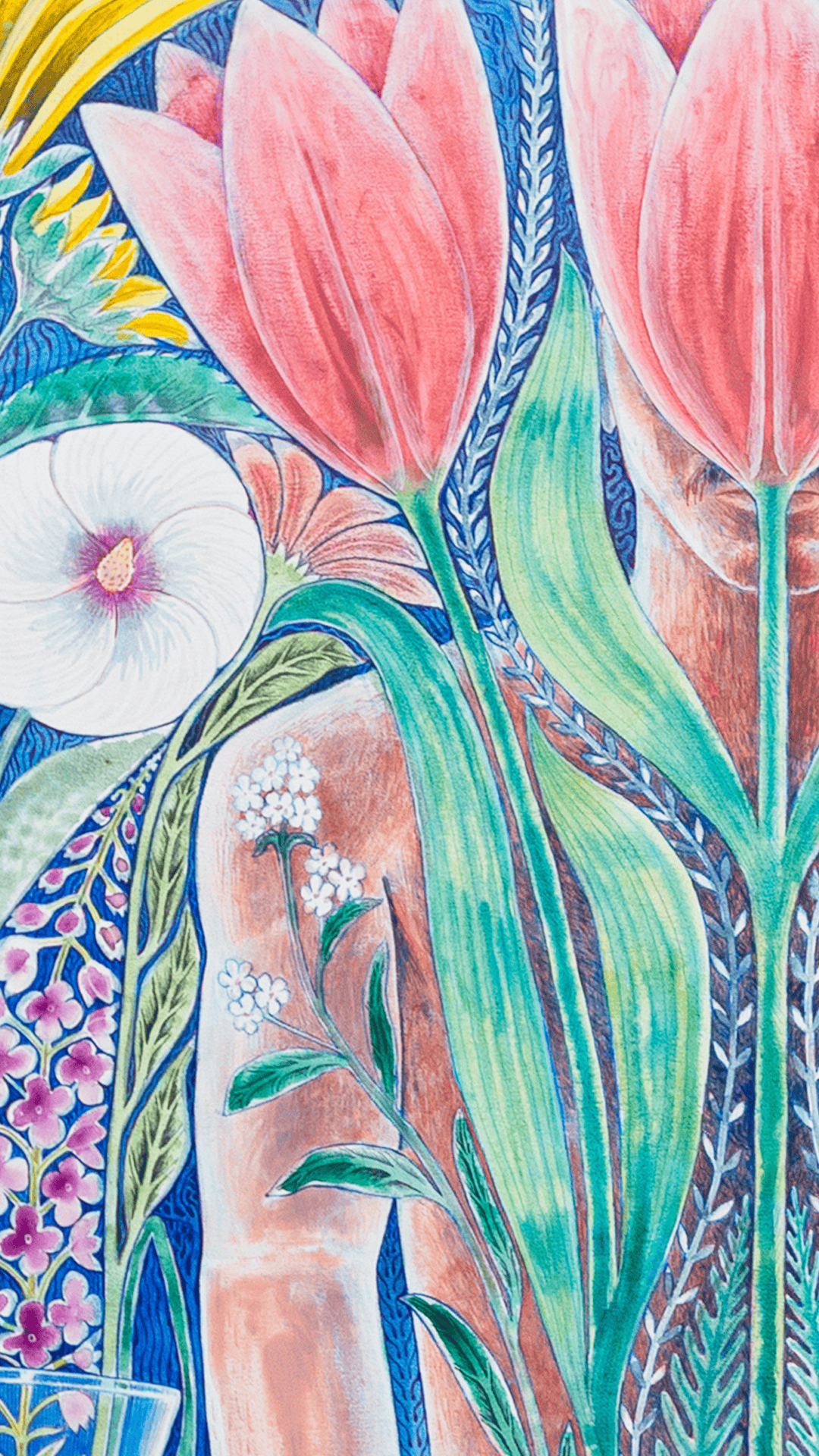
Detail of Bryan Rogers, BYOB, 2026
A central male figure appears anonymous, standing just slightly outside the central axis of the painting. Gently holding a vase, his head is obscured by a tulip, the petals perfectly in line with the sides of his face. Its vibrant leaves curl upwards to gently cover his ears, their interlocking forms superimposed, creating a symbiotic relationship which questions the notions of contemporary masculinity. In fact, the assemblage of floral forms which coalesce inside the squat vase seem to dress the naked figure. Like ornamental objects, strings of petals snake across his chest like fine jewellery, white bursts of flowers rest lightly on his shoulders and forearms as if tattooed on him. Tulip leaves rise and fall just over the tops of his shoulders, like shoulderpads, or a leafy armoured vest, enrobing him in their natural beauty.
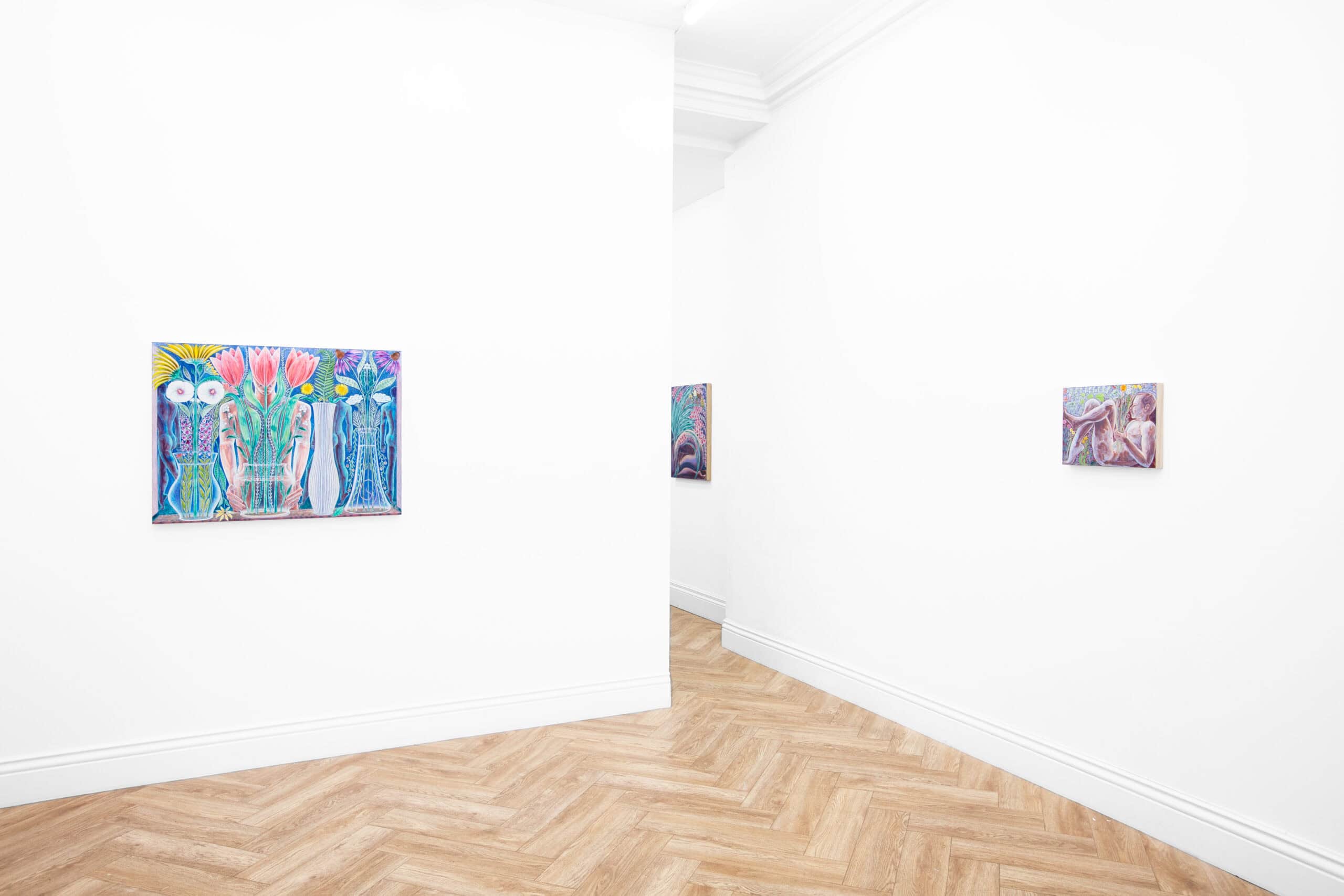
Sitting amongst the line of crystalline vases, rendered in precise white lines, a slender vase rises above all the rest. Its fluted form painted a pearly white, it looks opalescent, its gentle curves following the outstretched arms of the main figure. Alluded to in the title BYOB, these bodily forms root the painting in a domestic context, the vases mediating between exterior and interior worlds. Their centrality to the composition invokes a feeling of interiority, reflecting a kinship between queer bodies and the spaces they occupy. Rogers’ paintings, spatial investigations examining the queer body in public and private spaces, offer an open ended reflection on identity. Inviting the viewer to speculate on their connection with the natural world, Rogers explores how these domestic and natural settings not only refute performativity, but also offer a space of refuge and sanctuary
(By Emily Naughton)