Most recently I have been interested in the process by which definitions of the human are triangulated using reference points from the categories of the plant, the animal and the machine. I am especially interested in the way human subjects are raced and gendered through their relative proximity to particular elements within this matrix.
Molly Greene
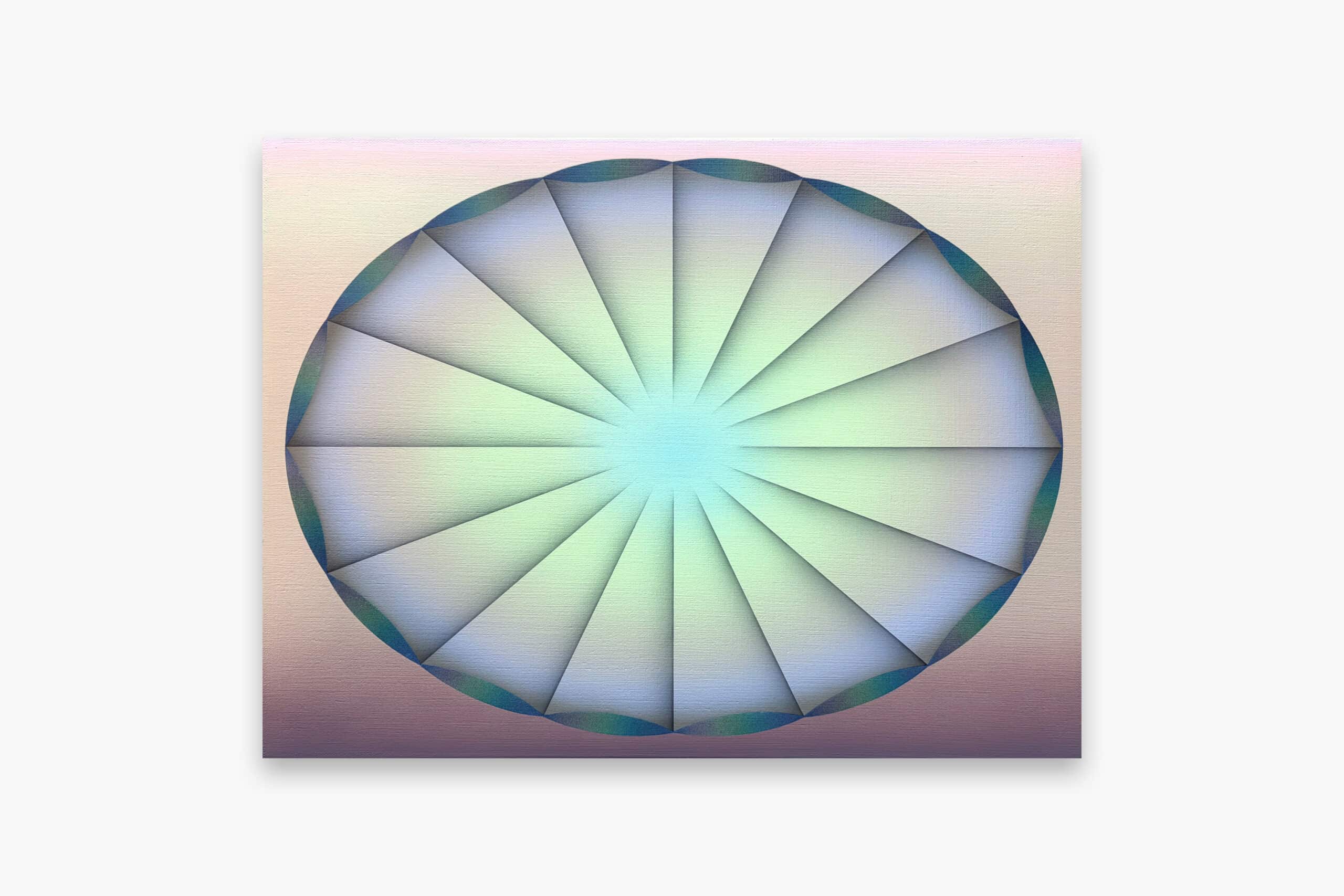
Quietly pulsating, a pale blue blur fades into a pastel technicolour; vivid greens become soft reds and lavenders. Phage evokes a particular kind of meditation through its ambiguity; the oculus which occupies the whole canvas imbued with a distinct corporeality despite its seemingly alien form. It is both organic yet mathematical, precisely split into sixteen identical segments. The technique of diffuse shading which gives it its curved form is used again in the horizontally shaded background, pale shades of pink dissolving into a much deeper purple near the bottom of the canvas. Its vacuous composition gives the form an unusual dogmatic dimension; aside from time, distilled in space, the micro bacterial form assumes a macroscopic scale, and similarly, a macroscopic presence.
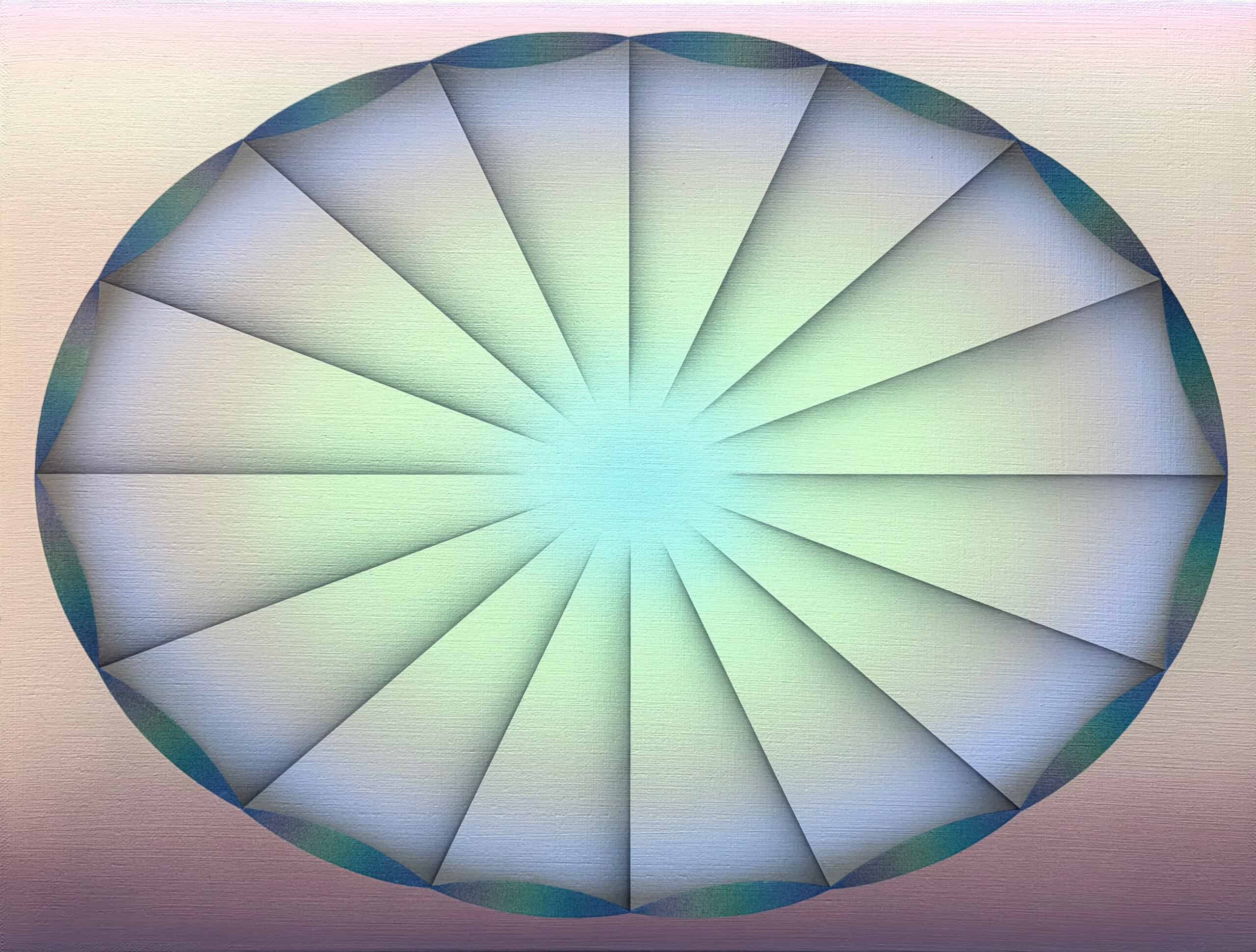
Molly Greene, Phage, 2026
Phages, the most common biological entities in nature, are viruses. Widely considered non-living, they are rife with agency; used to combat increasing antimicrobial resistance (AMR), they selectively kill certain types of bacteria. Greene, who completed a PhD in American Studies before turning to art, often depicts various plant and organic forms such as phages, allowing her paintings to become “aesthetic questions or responses within these fields of thought”. Her interest in posthumanism informs her work, and her various amorphous forms ask questions about inter-species relationships. Here, the basic components – the hazy turquoise nucleus safely protected by the cushion-like proteins, are abstracted, and scale lost, they are imbued with a certain universality as we are brought closer to them, immersed in their contemplative realm.
Compounded with an inert stillness, a gentle motion exudes from the canvas, its texture still visible beneath diffuse layers of paint. The slight shading which denotes each segment suggests this movement, yet the pinwheel form remains still; we must contend with this dichotomy. Greene’s work often subverts binary concepts, life/death, interiority/exteriority, natural/unnatural, looking to concepts such as animacy to interrogate our increasingly posthuman world.
Posited by Mel Y Chen in her book Animacies: Biopolitics, Racial Mattering and Queer Affect, animacy finds its place somewhere between animus and animate, questioning the very definition of the human in relation to the other. Building upon current anxieties surrounding the production of humanness in contemporary life, animacy, a quality of agency and awareness, allows us to contemplate how the immobile or insensate continually reinforce the rigid categorisations of the plant, the animal and the machine, the formulation of which reinforcing the superiority of the human. Using these theories, Greene explores the fragility and the fictionality of the human. Phage, in its depiction of an essential component of the human microbiome, questions the animacy of the seemingly inanimate. These blurred boundaries are represented in her fuzzy geometric, immersive paintings which invite us to oscillate between these binaries, lingering in the space between, made to confront the definition of human itself.
(By Emily Naughton)